



Table of Contents
Direct lobbying lets legislators be human.
A world without lobbying would require public officials to be prophets and experts in a wide range of areas who can foresee the future consequences of their policies.
Fortunately, that’s not the case. Political lobbying eliminates the need for legislators to have prophet-like abilities by bringing policies’ shortcomings to their attention. That is how change is initiated at the highest level.
So, what is direct lobbying, and how does it fit into the journey of change and progress? This post will answer that question.
What is direct lobbying?
Direct lobbying is defined as any attempt to influence existing or proposed legislation through interactions with:
- Any member (or staff) of a legislative body
- Any other government official or employee (apart from a legislative body member) who may participate in formulating legislation.
This interaction could be in the form of:
- Verbal or written communications
- Electronic or social media communications
- Attendance at a meeting with a public official
- A phone call with the public official
A representative of an interest group typically carries out direct lobbying communications. For example, a lobbyist appointed by an agricultural interest group is trying to propose a farm subsidy bill.
The lobbyist could either be a direct stakeholder or from an independent agency helping out the group.
Read Next: Grasstops Vs Grassroots and Why You Should Combine Both
What is NOT Direct lobbying?
It’s easy to confuse direct lobbying with other forms of communication with public officials to garner support for specific interests.
To be considered direct lobbying, interactions with officials must:
- Refer to specific legislation – either an existing one or one to be proposed by the interest group.
- Reflect a view on the bill – specifically with the technicalities of the bill and what must be changed.
It is not direct lobbying if communications are unrelated to specific legislations, including:
- Attending a meeting with a public official only to provide technical information or provide administrative assistance regarding the interest group activities.
- When a person schedules a meeting or a call purely administratively (even if lobbying is expected to occur in the meeting).
- Nonpartisan analysis, study, or research that presents all sides of an issue. Such discussions may not lead to a decision favoring the interest group.
These interactions are not considered direct lobbying, even if they directly or indirectly support it.
Direct lobbying activities examples
Applied to day-to-day work, that two-part test produces a fairly short list. These are the direct lobbying activities examples that would actually show up on an activity log at the end of a legislative session:
- A scheduled sit-down with a state senator to request a specific amendment to a numbered bill.
- A phone call to a committee staffer urging the chair to schedule — or shelve — a hearing on that bill.
- An email or letter to a legislator stating a support or oppose position on pending legislation.
- Testimony at a committee hearing that names the bill and takes a view on it.
- Handing a willing sponsor draft statutory language to introduce.
- The research, polling, and briefing memos produced specifically to support any of the above — the preparation counts as lobbying activity, not just the conversation itself.
The distinction matters beyond bookkeeping. A 501(c)(3) that has elected the expenditure test has to count the spending behind each of these against its direct lobbying limit, and most states set their own registration and reporting thresholds on top of that — so the same activity list can trigger a filing obligation as well as an advocacy result.
| Related reading: → IRS: Measuring lobbying activity — expenditure test |
What is direct and indirect lobbying?
While direct lobbying is often used alongside grassroots lobbying (or indirect lobbying), a few aspects distinguish both. Let’s compare direct lobbying vs. indirect lobbying:
| Direct Lobbying | Grassroots/indirect lobbying | |
| Objective | An attempt to change an existing policy or propose a new policy by an interest group. | Attempt to bring social, economic, or political change through public influence. It doesn’t necessarily relate to specific legislation. |
| How is it carried out? | Interest groups appoint a representative (or lobbyist) to interact with officials and change/introduce policies. | Any form of communication carried out on a mass scale, such as patch-through calls, click-to-call, social media tagging, etc. |
| Communication techniques | Any form of direct, one-to-one communication like a meeting, phone call, email, or direct mail. | Any form of communication carried out on a mass scale, such as patch-through calls, click-to-call, social media tagging, etc. |
| For more insights on grassroots lobbying, check out these articles: → Grassroots lobbying – Effect change through public support → Grassroots advocacy – Definition, strategies, and tools to get started |
What does direct lobbying entail?
For direct lobbying, lobbyists need to complete a few critical tasks to achieve the objective. While the lobbying strategies and techniques they leverage may differ, these tasks’ results are the same.
Direct lobbying typically involves the following:
1. Making personal contact with key legislators.
Meeting with legislators you’re trying to persuade in person is a crucial objective of a lobbyist. A personal interaction helps the lobbyist to:
- Clearly explain the issue they are trying to resolve and what legislation they are trying to change.
- Build a relationship with the official or staff member. Apart from helping them convince the official better, a healthy relationship also strengthens their network to help them with future lobbying efforts.
Emails, letters, phone calls, etc., are ways to make the first point of contact for the final objective of meeting with legislators in person.
| For more insights on how to prepare for the meeting with the legislator, check out this article: → How to effectively lobby in person |
2. Providing expertise and research results to legislators.
Public officials can’t just take the word of a lobbyist or an interest group and propose legislation changes. They need proof to back these claims. It is the lobbyist’s responsibility to:
- Conduct extensive research on the issue with multiple groups and present the findings to the official to support their claims.
- Provide expert testimonials to add credibility to their findings. These testimonials and the research results help them make a stronger case for the administration.
3. Providing legal advice and assistance to legislators.
Since the legislators may not be experts in the technicalities surrounding legislation, they would also need legal help to move forward with the proposal. Hence, lobbyists also have to assist officials to:
- Draft new legislation to be proposed. This includes suggesting amendments to existing law or creating one from scratch (proposing a bill).
- Ensure there aren’t any loopholes to contradict the proposal. Even if there are, you’ll have to guide them on how they can bypass it.
Direct lobbying is not just about influencing legislators. Lobbyists have the end-to-end responsibility of the process and are responsible for guiding key officials through it.
| Related reading: → A guide to legislative drafting |
Direct lobbying communication techniques
The most effective direct lobbying techniques all share one trait: they put a named person with a specific ask in front of someone who can move the bill. The four below are ordered roughly by the influence they carry, and most campaigns work through several of them in sequence rather than betting everything on one.
1. Personal meetings with elected officials
Personal visits or face-to-face meetings with key legislators are the most common and effective forms of direct lobbying.
Lobbyists often leverage their network to introduce themselves to officials and then schedule a meeting. They can also try to contact the official by email or phone to schedule a time.
Pro Tips
- Prepare a “one-page” synopsis of your topic. You may not talk to the public official for more than 15-20 minutes, so leave out the fluff.
- Get the official’s personal contact information. You’ll need this information to follow up with them and ensure they are actively working on your issue.
2. Personal visits to the staff of public officials
If you cannot reach the public official, your next best bet is to contact one of their staff members. You can schedule a meeting with them via phone or through your contact.
Senior staff members wield considerable power and can advocate for your issue before the legislator. Hence, don’t miss an opportunity to meet them and build a good relationship with them.
Pro Tips
- Make sure to discuss all the technicalities of the issue in detail. These staffers can give you more time and attention. The better they understand the problem, the more they may prioritize it and pass it to the official.
- Ask them for guidance on the best way to appeal to legislators. They have more insights than anyone and could guide you in crafting the appeal to make it more effective.
3. Sending a letter/email to public officials
Emails or direct mail are generally used as the first point of contact for direct lobbying. These letters or emails aim to give the official a gist of the problem and your plan to solve it.
In addition, emails and letters are also used to follow up with officials after a meeting or a phone call. This is to thank them and ensure they stay on top of your issue.
Pro Tips
- Keep it simple and focus on critical points. Don’t make the email or letter too wordy. Use simple terms and save the complex technicalities for the meeting. Explain the potential impact of the issue to get their attention.
- If you are sending a letter, send it as an email, too. While direct mail is highly personal and direct, it is often delayed due to security concerns. This, in turn, may delay your timeline. Send the letter as an email also to ensure deliverability. Even if the letter arrives later, it’ll remind the legislator to meet with you.
| Related reading: → How to write a letter to your legislator |
4. Phone calls to public officials or their staff
Since phone calls allow you to have a personal and direct conversation, they are the best alternative to in-person visits. Phone calls with legislators can be leveraged for direct lobbying:
- When you cannot match your schedule with the officials or their staff for a meeting.
- To follow up after your initial email to schedule a meeting
- For follow-up, after a meeting to get updates on the issue and resolve any further questions.
Pro tips
- Prepare a calling script to guide the conversation. It will ensure you cover all the key points you want to discuss with the official. Also, practice the call a couple of times, and don’t read out from the script. You wouldn’t want to sound like a salesperson narrating a script.
- Follow-up the call with a text or email to reinforce the conversation. The official may not remember all the key points you discussed during the calls. Send them a written copy to refer to later.
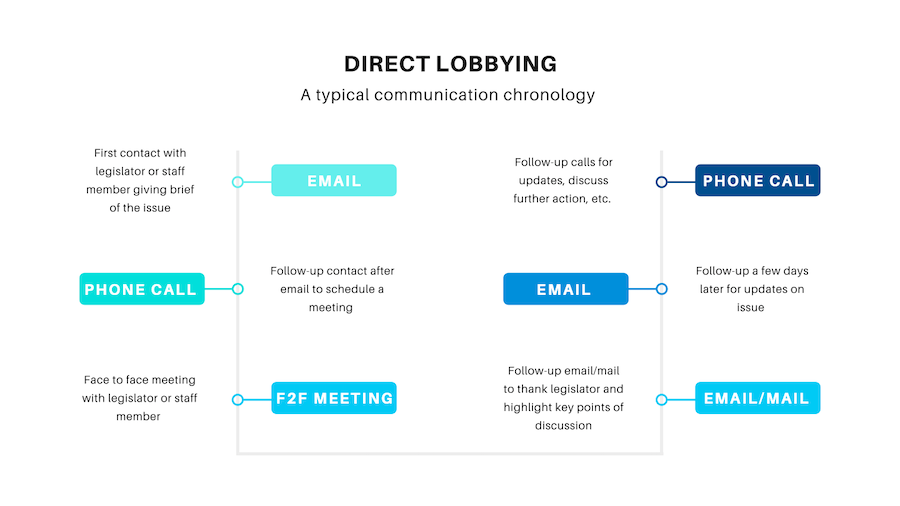
That being said, here’s what a typical direct lobbying communication timeline would look like:
Direct lobbying strategies examples
Techniques describe the channel; a strategy describes how you use it on a live bill. Each of the lobbying strategies examples below is a direct one — the group or its lobbyist is talking to a decision-maker about specific legislation, never to the general public.
- The amendment request. An agricultural association’s lobbyist takes a member of the agriculture committee through a two-line change to a subsidy bill, with the redlined text ready to hand over at the end of the meeting.
- Invited committee testimony. A trade group’s policy director testifies at a hearing on a specific bill number, states a clear support-or-oppose position, and leaves the data behind on the record.
- Writing the bill. Rather than reacting to someone else’s draft, the group supplies model language to a sympathetic sponsor and lets them introduce it.
- The markup-window staff briefing. While amendments are being marked up, the lobbyist sends committee counsel a one-page fiscal analysis answering the objection that came up in the last hearing.
- The coalition sign-on letter. Several organisations put their names on a single letter to the committee chair asking for a yes vote on a named bill — one document, many constituencies.
Notice what keeps all five in the direct column: a piece of named legislation plus a stated view on it. At the federal level, each of these exchanges is also a reportable lobbying contact, which is why disclosure filings are a useful place to see what strategies real groups are actually running.
| Related reading: → The Lobbying Disclosure Act (full text) |
Direct lobbying challenges
While direct lobbying can help you bring about change, it comes with its own set of challenges that you need to tackle. The two significant challenges with direct lobbying include:
- Accessibility
- Motivating legislators
Let’s understand each of these challenges and how you can overcome them.
1. Accessibility
The first challenge with direct lobbying is getting access to key legislators. Getting their attention with a phone call or over an email is not easy. They get hundreds of such correspondences, so getting lost in the crowd is easy.
Plus, if they are not as keen on the issue, they can even ignore your outreach efforts, making it harder to arrange a meeting.
Solution
There are two ways you can get the legislator’s attention and get them to schedule a meeting.
- Chasing
Quite literally, chasing is the attempt to contact the senator on the fly. Lobbyists often wait around the capitol to catch legislators when they enter or exit the building or move between houses.
The aim here is to convey a few points on the fly and get them interested in the cause. Once you have their attention, it becomes easier to schedule a meeting later. You can also try this technique with the legislator’s senior staff members.
- Throwing fundraisers
Apart from chasing them, lobbyists also gain access to congresspersons by assisting them with campaign finance. Political fundraising is carried out by setting up PACs and seeking donations from people and organizations.
This helps incumbent members cope with the substantial time required to raise money when they decide to run for office again. This earns you a significant favor with the official and gets their attention. PACs are reasonably easy to set up; you only need a lawyer and about $300.
| Related reading: → How to register as a PAC |
2. Motivating legislators
Another challenge with direct lobbying is that it requires much effort from the legislator. The issue itself may not motivate them enough to put in that effort.
You need to offer an incentive to get them interested in working for you. The incentive could be public support, funds for reelection, or anything on those grounds. However, lobbyists may not always be able to guarantee that incentive.
Solution
There are two ways you can guarantee these incentives and motivate officials to change legislation.
- Leveraging an influencer
This could be a celebrity, a community leader, or anyone with a large following who can mobilize his/her followers when necessary. An influencer can guarantee the support a legislator needs.
Moreover, influencers may also carry a lot of clout in the office and help you connect with key officials. So, getting influencers on board early in the campaign is worth considering.
You could reach out to influencers or leaders who share your thoughts on the issues you’re fighting. Once you get them on board, let them spearhead the interactions with the official and lobbyist, if necessary.
For example, Angy Rivera is an influencer who is leading the efforts for equal opportunities for undocumented youth.

- Luring staffers with lobbyist roles
As mentioned earlier, senior congressional staffers have considerable power and can exert influence over a legislator. Motivating a staff member can be equally effective as encouraging the officials themselves.
Lobbyists often get favors from these staffers in exchange for the promise of a high-paying lobbyist job after they decide to leave public office. Such a reward usually motivates them to help lobbyists push the issue to the legislator and the administration.
Direct interest group strategies examples
Organised interest groups rarely improvise their access. Watch how trade associations, unions, and professional bodies run direct lobbying and the same structural choices keep reappearing — all of them one-to-one with decision-makers rather than public-facing:
- In-house team or contract lobbyist. Large associations keep salaried government-affairs staff so relationships survive between sessions; smaller groups retain a contract lobbyist for one bill or one session and pay for their existing relationships instead.
- Recruiting former legislative staff. Hiring someone who used to work the committee buys familiarity with the members, the calendar, and which staffer actually drafts the language.
- Committee-first targeting. Instead of working an entire chamber, the group concentrates on the handful of committee members, the chair, and the chair’s counsel who decide whether the bill moves at all.
- Lobby days that use members as expert witnesses. A professional association flies in practising members for back-to-back office visits; a constituent who is also a subject-matter expert is harder to turn down than a paid representative alone.
- An in-house research pipeline. The group commits to producing the bill-specific analysis officials can cite publicly, which makes it the office’s default source on that issue next session too.
- Campaign-finance support as an access strategy, in the way described in the accessibility challenge above — with the substantive ask still made in the meeting, not at the fundraiser.
If you want to check which of these a particular group is using, the public disclosure filings name the registrant, the issues, the bills, and the chambers contacted each quarter.
| Related reading: → Search federal lobbying disclosure filings |
Read Next: Social Media Advocacy: Everything You Need To Know To Get Started
Direct lobbying FAQs
How can indirect lobbying activities be influential?
Indirect lobbying activities are influential because they change the political conditions a legislator is deciding in, rather than arguing the case to them one-to-one. When a few hundred constituents call, write, or post about a named bill, that volume gets read as a preview of how the district feels — and congressional staff themselves report that constituent contact moves an undecided member further than a paid lobbyist’s visit does (see the Congressional Management Foundation’s Communicating with Congress research).
The influence itself comes from three places: electoral signal, since contact volume acts as a proxy for votes back home; public and media pressure, which makes staying silent on the issue costly; and political cover, because a legislator who can point to visible public support has a reason to spend capital on your bill. That is also why indirect activity works best feeding into direct lobbying — the public pressure creates the opening, and the meeting closes it.
What is one strategy that lobbyists use?
If you had to name a single one, it is the prepared face-to-face meeting: a lobbyist secures time with a legislator or a senior staff member and arrives with one specific ask on a named bill, a one-page brief, and evidence the official can quote in committee. Federal disclosure rules point at the same behaviour — the unit lobbyists have to report is the “lobbying contact,” a direct communication with a covered official about specific legislation (see the House’s Lobbying Disclosure Act guidance), which is why one-to-one contact rather than public campaigning sits at the centre of most lobbying programs.
The strategy is only as strong as the preparation behind it, though: a vague meeting with no bill number, no ask, and no written follow-up rarely changes a vote.
Conclusion
Direct lobbying is a critical part of the policy-making process in a liberal democracy. It’s only by bringing an issue to the administration’s attention that you can influence policy changes. And direct lobbying is an effective way to achieve that.
Direct lobbying is a critical part of the policy-making process in a liberal democracy. It’s only by bringing an issue to the administration’s attention that you can influence policy changes. And direct lobbying is an effective way to achieve that.
Hopefully, the points above will help you create a solid plan for direct lobbying and bring change. You could also leverage software to boost your direct lobbying efforts. Here’s a list of the top 10 advocacy software that we recommend.
Featured image: Romain V